
Conversational in 6 months: case study
The process is simple

Introduction
Wow, 2 case studies in 2 days! If you didn’t read yesterday’s 1-year progress summary, you can do so here. To read all case studies I have written, visit the homepage of my website and scroll about halfway down the page.
I love these case studies because they demonstrate with real proof that learning a language is straightforward. Anyone can do it.
General progress overview
This student was an absolute beginner in French when she started learning 6 months ago (September of 2025). Now she is able to carry 1-1 conversations. Furthermore, her spoken grammatical accuracy is high. For instance, today in a 30-minute conversation she only needed help with conjugations twice and she didn’t make too many mistakes overall. Her speech rate is normal too given her level, which is great.
How she spent her time
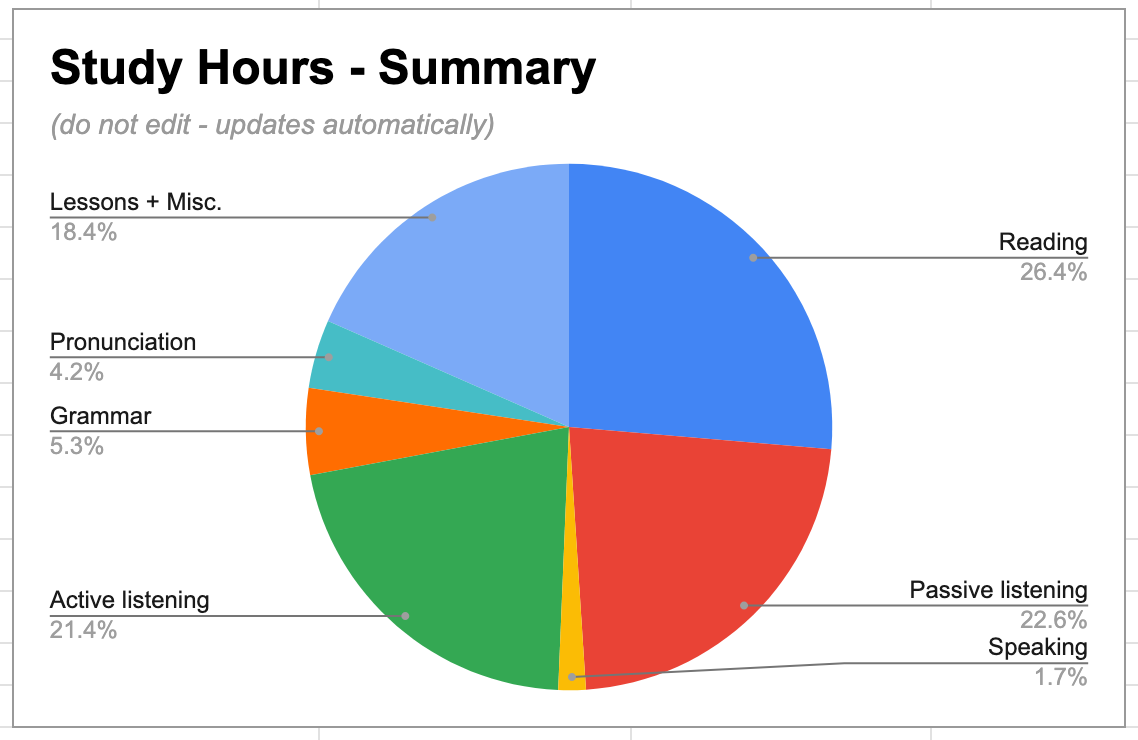
On the chart below, “speaking” refers to at-home speaking drills. It doesn’t refer to conversations with me (her tutor) or native speakers. Her time in-class with me has been dedicated primarily to conversation practice. She has studied a total of 267.5 hours. That equates to 1.5 hours of study a day over the past 6 months.
Observations about her level
This is another example of a student who improved drastically by primarily doing listening + reading, followed by speaking as a distant second. Her grammatical accuracy is reasonably high despite barely studying any grammar.
Most people think you improve grammar by studying grammar. This is just not true. Grammatical mastery comes mostly by doing lots of listening and reading, supplemented by a moderate amount of speaking.
Potential good news
Next, it’s interesting to see that this student has a similar level in French as I do in Ukrainian despite studying 2x more intensively. I have done 279.5 hours of Ukrainian study in 1 year. She has done 267.5 hours in 6 months. It’s almost the same amount of hours, but condensed into a 6-month time frame.
I am cautiously optimistic about this. It is an indication that what matters is the amount of hours one studies. Your desired level of fluency might require, say, 100 hours of study. You could get that done really fast by studying lots or more gradually. Spreading it out doesn’t seem to make a difference. You can take a break and come back to your studies without sliding backward.
I could be wrong about this as I don’t have enough data to definitively prove my idea. It’s just a hypothesis at this time.
Vocabulary acquisition
Here’s a fun fact I don’t talk about often. The many case studies I have done have indicated to me that people learn new words at approximately the same rate. For instance, this student has increased her active vocabulary size by 7.7 word families per hour. 4 to 8 word families per hour has been the norm from the language learners I have been observing and working with.
You can do it!
The framework I recommend that seems to work wonders is:
Listen and/or read daily
Speak 2 days per month
You may also study grammar 1 day per week, if you want. For more detailed instructions and resources to follow this plan, click here.
Thanks for reading! Wishing you the best of luck. I believe in you 😊
Azren
Calgary Language Nerds owner
https://azrenthelanguagenerd.com