
HUGE Milestone! 👏👏👏
I can't believe this just happened

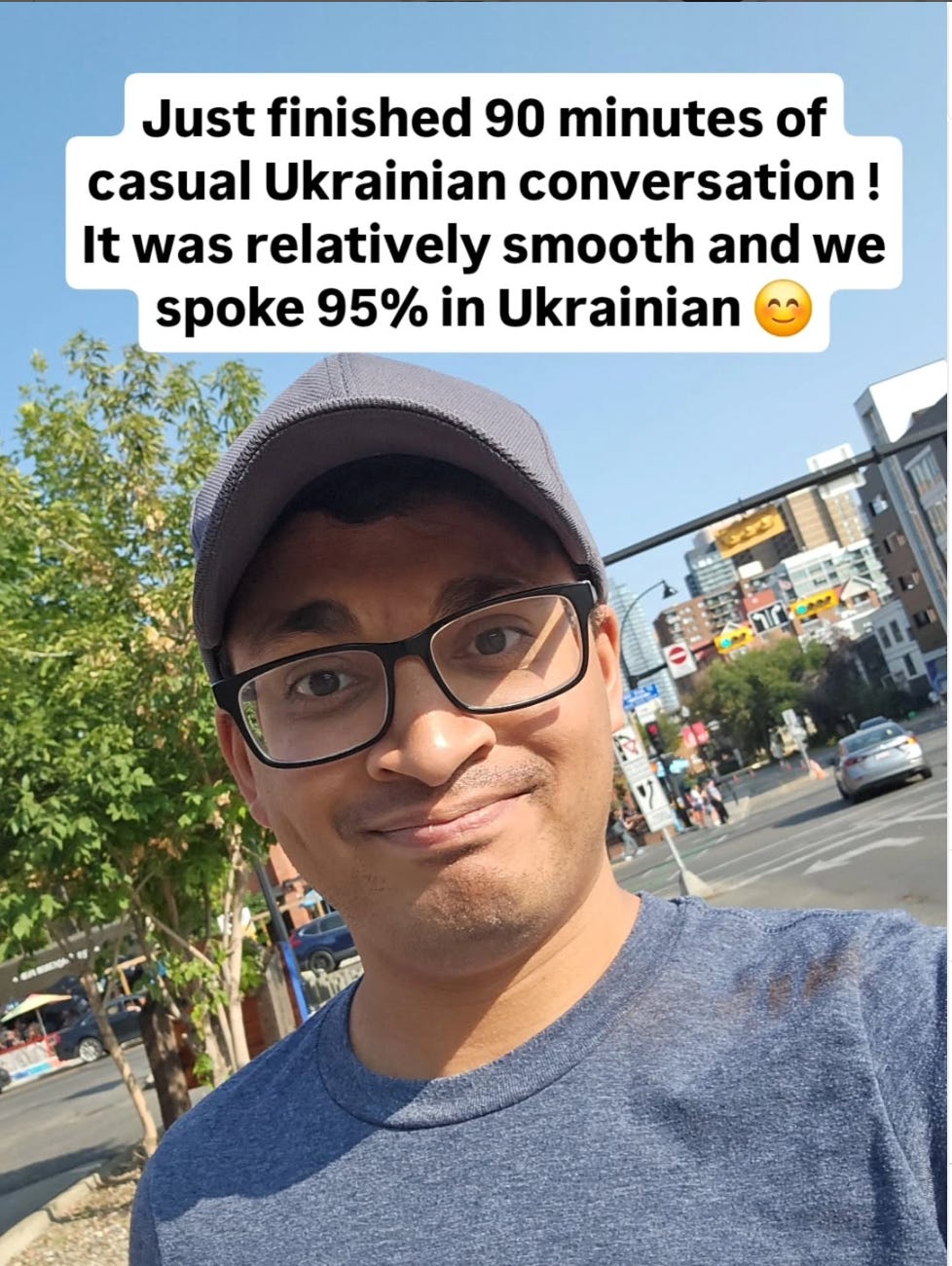
I took this picture earlier today.
I met up with a new Ukrainian friend in Calgary. We hung out for 90 minutes…and we spoke in Ukrainian the whole time!
I’ve never learned a language this fast.
Normally it takes me much longer. For context, let’s compare my Mandarin progress with Ukrainian. About 8 months into my Mandarin journey, I went to China. I couldn’t communicate at all with my homestay family. The father even introduced me to someone around my age so I could have a friend and we were forced to rely entirely on an online translation app to communicate.
I had studied about 160 hours of Mandarin at that point.
On the other hand, in Ukrainian…
I am 5 months into learning Ukrainian. I’ve studied for about 1 hour a day (162 hours to be exact). This time around, I was able to hang out with a native Ukrainian speaker and have free-flowing conversation…for 90 minutes!
That’s a night and day difference.
It’s also worth mentioning that I have had other conversations prior to today, though they were usually with my tutor. In the rare circumstances that they weren’t with my tutor, the conversations were much shorter than 90 minutes.
So what’s changed? Why am I progressing faster in Ukrainian?
In short, I am using the methods in my Guaranteed Fluency program. Remember, I spent 2 years developing this program, trying to identify simple and effective study methods that reliably work. Ukrainian has been my way of testing the methods on myself to experience them first-hand.
Let’s compare how I learned Mandarin as a beginner vs Ukrainian.
See below!
How I studied Mandarin for the first ~160 hours:
Group classes
Textbook learning
Memorizing word lists
Worksheets for homework
Watching some YouTube lessons
Lots of in-class grammar instruction
Practicing pronunciation at home
How I studied Ukrainian for the first ~160 hours
Active listening (watching videos at my level and looking up words I don’t understand)
Passive listening (same as active listening, but no pausing to look up words. I just try to soak it all in)
Conversation practice (with a 1-1 tutor)
A small amount of grammar study
Practicing pronunciation at home
In other words…
I’m spending the majority of my time in Ukrainian on listening and speaking, not on studying. When I learned Mandarin, it was the reverse: lots of studying, not much authentic speaking and listening.
Another way to view it is this:
Mandarin: Information was generally presented to me in an orderly, structured fashion (PowerPoints, textbooks, workbooks, etc)
Ukrainian: Information is generally presented to me in a natural, free-flowing manner through authentic listening material and conversation
Don’t get me wrong: I do still “study” Ukrainian. I watch grammar videos, do some exercises, and try to memorize information.
It’s just not my primary focus.
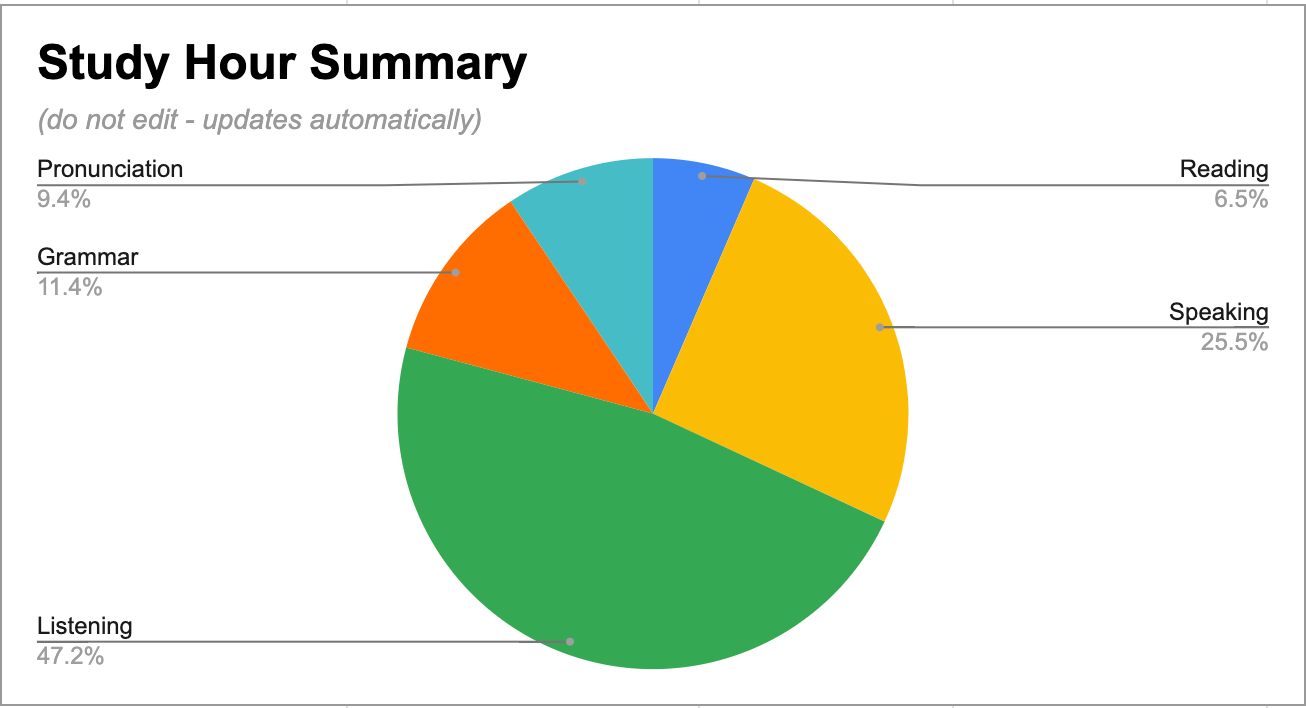
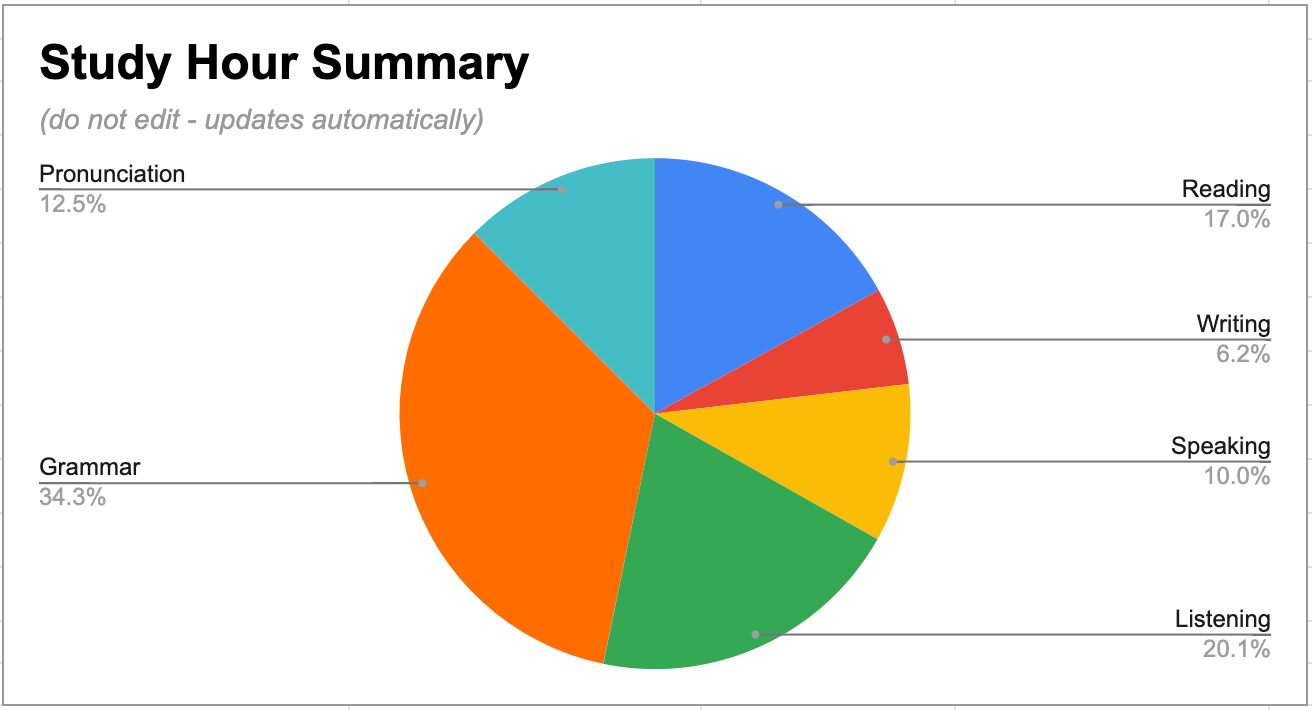
A precise breakdown of how I’ve dedicated my time.
When looking at these charts, what’s most important is not just the data of how I spent my time, but also mentality I had for each language.
In Ukrainian, I am mostly flowing. In Mandarin, I was mostly studying.
This is a key difference, in my view.
Ukrainian ~160-hour summary:
Mandarin ~160-hour summary
The Mandarin study hours have some margin of error as I wasn’t tracking my study time back then like I do now. However, I believe it to be relatively accurate because I distinctly remember my first 8 months of Mandarin study and the approximate workload. I had just finished my Bachelor’s and started my after-degree program in East Asian Language Studies.
Thanks for reading!
I really appreciate it ❤️ Best of luck with your language journey. I hope this case study was insightful and helpful for your own studies.
Azren
Calgary Language Nerds owner
https://azrenthelanguagenerd.com
Hi Azren, as a Ukrainian and a person who speaks Chinese I would like to express two points:
1. I can’t express enough how my heart melts when a person learns Ukrainian! The results you have already are fascinating! Мені дуже приємно, що Ви вивчаєте мою мову☺️
2. Comparison to Mandarin is a different angle I never faced before. Both languages are from different language families, of different entry points. However, I see your point on opposite approach to learning these two languages. I used similar approach before to learn Korean as it doesn’t require learning tones and characters compared to Mandarin.
Very interesting! And congratulations.