
When will you be fluent?
A definitive answer

Summary of today’s blog post.
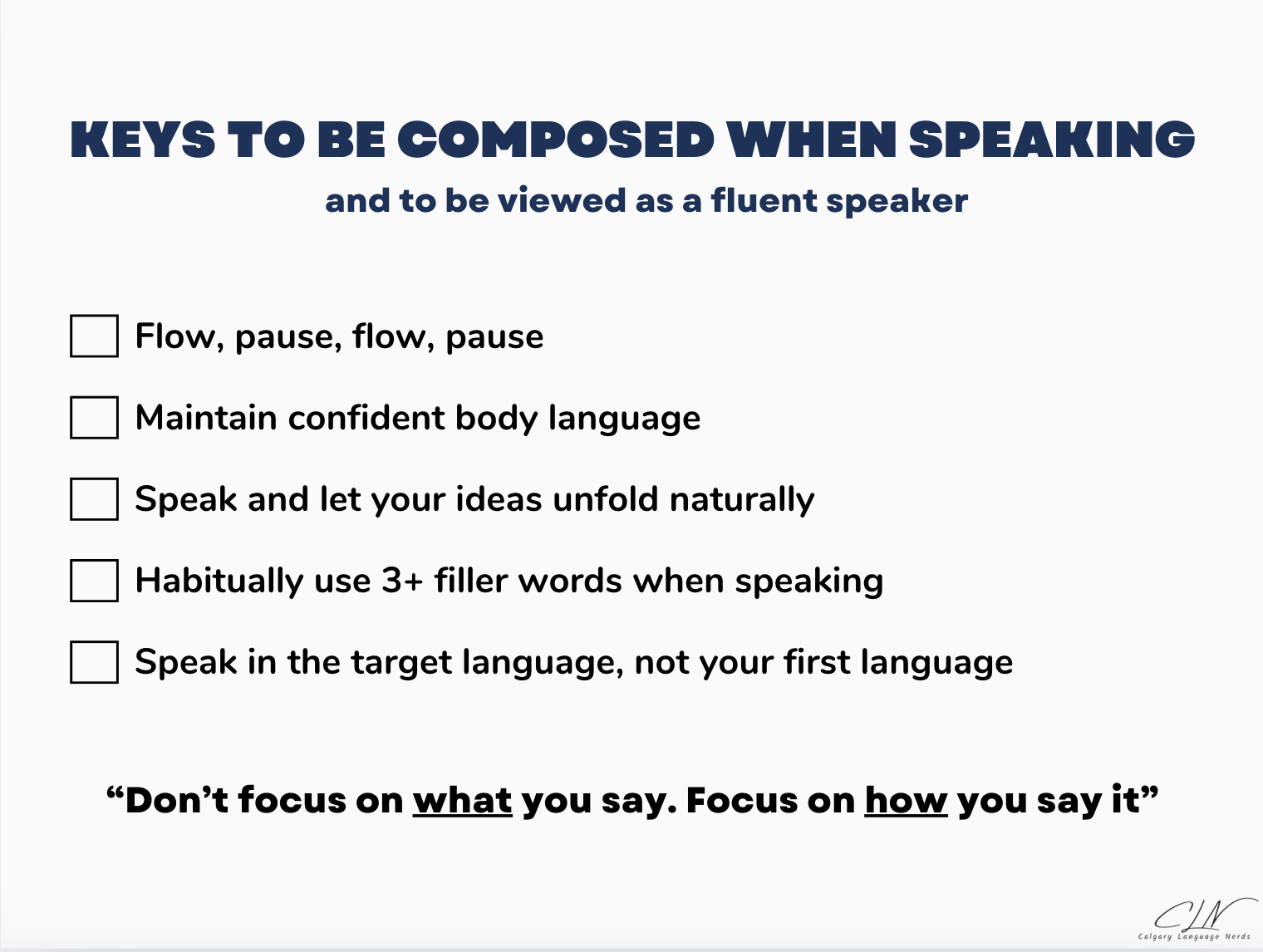
You will be perceived by native speakers as fluent when you can:
Consistently hold 30+ minute free-flowing conversations
Habitually use filler words in the target language when speaking
Maintain confident body language in all conversations
Speak and allow your words to unfold naturally
Flow when speaking
In my estimation, being perceived as fluent can be accomplished 6 months of doing 3 hours a week of study. It is worth noting that these 5 criteria account for conversational fluency, not for other skills such as reading, writing, or understanding TV shows/movies/music.
Let’s dig further into each of the five criteria.
Criteria #1: Hold 30+ minutes of free-flowing conversation.
This is the bread and butter of fluency. If you can’t hold a conversation, you are not fluent. It’s remarkably straightforward to improve your speaking skills: find a tutor or a friend to practice conversing with you. That’s it. Don’t overcomplicate it.
Criteria #2: Use filler words in the target language.
Most language learners use filler words from their first language. An English speaker, for example, would use words such as um, like, so, and y’know. Swap those out for filler words in the target language. Get in the habit of using them.
Criteria #3: Maintain confident body language.
On Zoom, pay attention to your head and face. Don’t do these:
Wince when you make a mistake or don’t know what to say
Instead, keep your face neutral and make mistakes with confidence.
Make wild head movements (side-to-side or up toward the sky) when trying to think of your next words
Instead, make subtle head and eye movements. Subtly look up or to the side when thinking of your next words
Have an expressionless face. This is typical of people who are very nervous.
Instead, wear a slight smile at a bare minimum. Nod slowly from time-to-time to indicate you’re listening
In-person, do all of the above and have:
Good posture
Open body language
Criteria #4: Allow words to unfold naturally.
A common misconception is that you need to plan out exactly what you’ll say in advance. While doing this is useful for some people, I’ve found that generally it’s better to allow words to unfold unnaturally.
Let’s look at criteria #5 to learn how to do this.
Criteria #5: Flow when speaking.
Focus on how you speak. It matters more than what you say. From day 1, practice imitating native speakers. I’m currently working on a framework to teach the idea of flow. The one I use right now is called:
Flow, pause, flow.
In other words, flow naturally by saying a short phrase. Then, pause to think of your next phrase before flowing naturally through the next phrase. Rinse and repeat for the duration of the conversation.
Most language learners don’t do this. They, instead, speak in a clunky fashion. As a general rule of thumb, if you open your mouth, the words must flow as naturally as possible. No clunky speech allowed.
Bonus: Think aloud.
This ties into the previous point about flow. When native speakers are searching for their words, they tend to think aloud. For example, if I were talking about an unfamiliar topic I may say:
Hmmm…I dunno, that’s actually kinda interesting because like…I guess I’ve never really considered this before and, well, it’s a little tricky. -Pause- I suppose I could say…
Notice that almost everything there has no meaning. They’re just words I’m using to process my thoughts out loud. But it sounds natural. Language learners don’t do this. Instead, they freeze up or awkwardly trudge forward, stumbling over every word.
As a summary, practice the right things to become fluent.
While language fundamentals are important (grammar, vocabulary, pronunciation, sentence structure, reading, writing, etc) they’re not nearly enough to have fluent speech. You also need to practice:
Holding reasonably long conversation (30+ minutes)
Swapping out filler words in your mother tongue for ones in your target language
Maintaining confident body language
Speaking and allowing your words to unfold naturally
Embodying flow when speaking
Do that alongside your traditional study, and fluency will quickly be within reach.
My business teaches these 5 criteria.
Happy to set up a free trial for you if you are interested. Contact me!
Very good points. I’m using all of these with Catherine every week. And I’m practicing them on a daily basis in my conversations with fellow learners.