
You're probably learning a language inefficiently

Millions of people across the world are learning a language. And most of them are going about it inefficiently.
What does it mean to “study” a language?
For most people, studying equates to:
Using textbooks
Attending classes
Doing worksheets
Completing grammar drills
Memorizing words and phrases
Doing flashcards
Working through apps
There’s nothing inherently wrong with any of the above. It’s just that, in general, it leads to slower results. Furthermore, it makes learning feel hard.
How I define “studying”
For me and students I teach, there are four study activities.
Activity 1: Listening practice
There are lots of ways to do this. I describe a few of them here. There are other types of listening practice activities too, but those are a great place to start.
Activity 2: Reading practice
Read any fiction (e.g., short stories, books) or non-fiction (e.g., news, essays, blog posts). Look up words you don’t know and read material at your level.
Activity 3: Conversation practice
I usually have people do this at home by completing at-home speaking exercises and by participating in live conversation with native speakers. Both have their place.
Activity 4: Writing practice
I have beginners just write short sentences using words grammar they know. Once someone has a stronger base in the language, I give short writing prompts. Writing is a half-step to speaking; it often improves conversation ability.
Wait…that’s it?
Pretty much, yes. For me studying a language mostly just means listening, conversing, reading, and writing frequently. It does not mean using textbooks, downloading apps, completing worksheets, memorizing words, or anything else that most people label as “studying a language.”
Or rather, to be more specific, I have people spend:
90% of their time on speaking, listening, reading, and writing
10% of their time on other forms of studying
The 10% of grammar drills, apps, flashcards, and other forms of study still have their place. But only from time to time. And honestly, if all you ever did was converse, listen, read, and write, you’d do just fine and reach your goals.
It’s super simple.
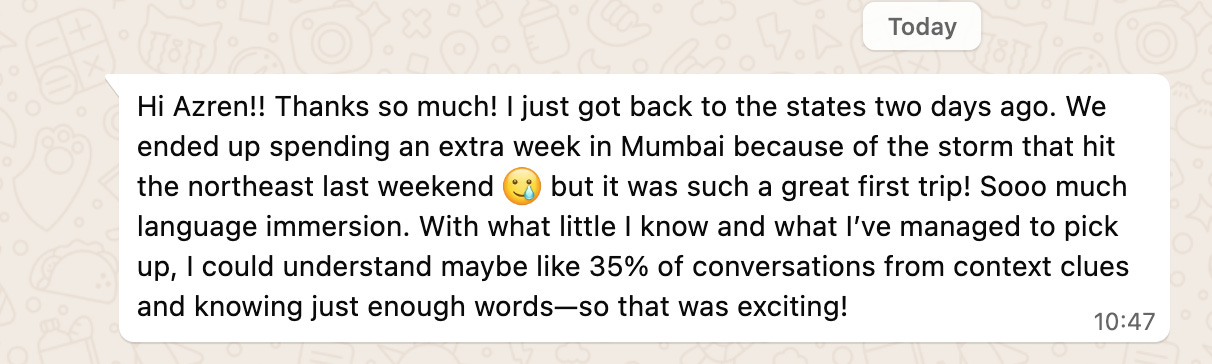
That’s been the biggest thing that has surprised me in 2026. It’s just not that complex. I mean, check out this text from one of my students. She was a complete Gujarati beginner when I met her. She has had four lessons with me so far. Yes. Just four.
All I’ve had her do is some simple listening drills and speaking at home. In-class we’ve done pretty much the same.
It’s not magic.
I haven’t found a magic wand that makes you fluent overnight. I also am not necessarily using a super unique and revolutionary method that someone how makes your brain acquire a foreign language like magic.
I’ve just gotten better at reducing cognitive load.
Focus on what matters
Keep it simple. Don’t waste mental resources.
Thanks for reading!
Azren
Calgary Language Nerds owner
Visit my website
Request a consultation for private lessons